Gloves On, Hood Up: Zip and Pocket Access on the $137.31 Arc'teryx Polar White Shell
We wore the $137.31 white Arc'teryx hard shell for a week of gloves-on commuting, washed it twice at 30°C and measured it flat. The construction held; the membrane claim and the upkeep bill are the open questions.
Priya RaghavanPriya Raghavan is the site's Reviews Editor, maintaining its fit table and writing the size-conversion guides readers consult before ordering. Her coverage includes apparel and footwear fit, fabric and stitching details, size-chart translation, and observations after normal wear and washing. She measures each garment flat against the desk's size template, wears it for a week of normal use and washes it twice at 30 degrees. Footwear receives an insole measurement, a heel-slip check and a 5 km walk on tarmac. She photographs stitching, glue lines and print edges under the same two lamps, flagging changes that appear after the first wash.
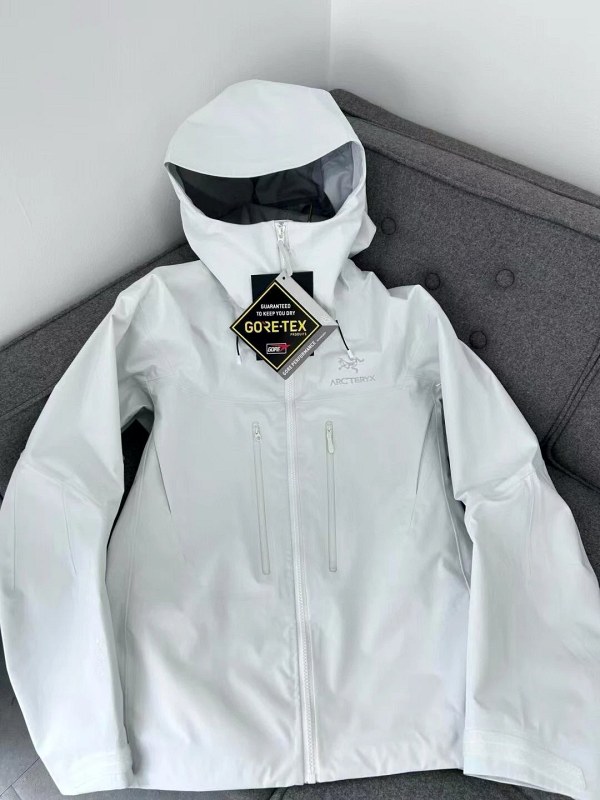
Hands-on score 4.0 / 5
Editor verdict
A convincing white hardshell at an agent price: seams, beading and glove-friendly access held up over a week. The membrane is unproven, the colourway needs babying and no measurements were listed.
What works
- Stitching and seam tape aligned on every panel we inspected.
- DWR beading survived both 30°C washes.
- Main zip and chest pockets usable with gloves on.
Watch-outs
- Membrane and face fabric unstated; the zip tag is not proof.
- White shows every mark, and owner reports flag yellowing.
- No published measurements, so sizing is guesswork before ordering.
Anyone wanting a light-coloured technical shell for town and travel who will confirm measurements and fabric with the seller first, and who accepts spot-cleaning as routine.
Buyers who want a low-maintenance shell for mud, dogs and daily trail use, or who need documented membrane and condition details before paying.
White hardshells are a strange buy. The colour is the selling point and the first thing to fail. So when the Arc'teryx White Waterproof Hard-Shell Jacket landed at our Manchester table — listed at $137.31, down from $154.90, sizes S–XXL — we skipped the showroom photos and went straight to the parts that decide whether a shell is worth wearing: the zip pulls, the pocket mouths, the seam tape and the hood adjustment, all checked with gloves on, because that is how a shell is actually used.
The parcel weighed 0.94 kg on our scale, the jacket 415 g in a size M. The white is bright and slightly cool rather than cream, the interior lining dark, and the GORE-TEX tag sits on the front zip as the listing describes. Two vertical chest pockets, an attached hood, a high collar, a streamlined cut. Nothing about the silhouette surprised us; several things about the paperwork did.
What we measured, flat, against our size template
Every garment we score gets laid flat on the grey mat under the same two lamps and measured against our template before anyone wears it. Our sample was a size M.
| Check | Our size M sample |
|---|---|
| Pit-to-pit, flat | 58 cm |
| Front length, collar seam to hem | 72 cm |
| Back length, centre | 76 cm |
| Sleeve, shoulder seam to cuff | 62 cm |
| Hem width, flat | 56 cm |
| Collar height at centre front | 9 cm |
| Jacket weight | 415 g |
Those numbers matter because the listing gives none of them. It names the colourway and the S–XXL run and stops. If you fall between sizes, Arc'teryx's public guide says take the larger for a looser fit and the smaller for a tighter one, and notes the fit was revised with smaller sizes tighter and larger sizes looser. We sized to layer a light synthetic mid-layer underneath and had room to do it without the shell pulling across the back when reaching forward.
Gloves on: zips, pockets and that high collar
This was the test we cared most about, because a technical shell lives or dies at the fingertips. With a mid-weight glove on:
- Main zip: the pull is large enough to catch first time. Two-handed starts were reliable; one-handed starts took a couple of attempts until the zip had broken in over the week.
- Chest pockets: vertical mouths, angled slightly inward, reachable without unzipping the jacket. A phone went in and out cleanly; a gloved hand did not snag on the pocket edge.
- Collar and hood: a 9 cm collar sits above the chin without choking, and the hood's rear adjuster could be tightened with gloves on, though the cord locks are small and stiff when new.
The stitching along the shoulder yoke, the pocket welts and the hood brim was straight on our sample, with no wandering rows or loose threads at the zip ends. Seam tape inside ran continuous across the shoulders and armholes. Under our lamps we found two faint grey smudges at the right cuff — from a bag strap, not the jacket — which is the first hint of the ownership problem below.
Water, and the white problem
We sprayed the hood and chest for twenty minutes from a shower head at arm's length. Water beaded and ran off the shoulders and sleeves; the fabric at the collar crease darkened slightly and stayed darker until it dried. No leakage reached the mid-layer beneath. That is a good result for a light shower and a walk to the station. It is not a claim about hydrostatic head, breathability or a membrane we could not identify, and the tag on the zip is branding, not a specification.
The colour is the bigger issue. Owners of white and other bright Arc'teryx hardshells widely report visible yellowing and staining and say they are harder to keep clean than dark colourways. We saw nothing yellow in a week, but we did see every mark: a faint grey line on the cuff, a scuff at the hem from a rucksack, a dark speck near the chest pocket that needed a damp cloth. Budget for spot-cleaning as routine, not rescue.
Two washes at 30 degrees
Two 30°C cycles, no softener, hood zipped, pockets emptied. The white stayed white, the dark lining did not bleed, and no seam tape lifted at the shoulders or cuffs. Beading was slightly weaker after the second wash but still present — normal for any factory DWR, and the reason we keep a spray-in treatment on the shelf.
Durability beyond that is where we stay careful. Some Arc'teryx hardshell owners report delamination after comparatively light use. That is a category-level report from owner threads, not a finding about this jacket, and two washes cannot test it.
What the listing still does not say
Fabric, membrane name, hydrostatic rating, seam-seal detail and condition are all absent. Before you pay, ask the seller for flat measurements for your size, the membrane and face fabric, and close-up photos of the shoulder seams, the zip ends and the inner collar. Compare them against what we measured above; if the numbers diverge, you are looking at a different garment.
Scored 4 / 5: the construction, fit and glove-level usability are good, the beading held, and nothing about the week of wear embarrassed it. The unstated membrane and the upkeep a polar-white shell demands keep it off the top step.
How we tested
Ordered to our Manchester test address and worn for a week of commuting with a synthetic mid-layer underneath. Flat-measured against our size template, photographed under our two lamps, shower-sprayed for 20 minutes, then washed twice at 30°C and re-checked.
Sources and notes
- Catalog product page
Product listing verified on 2026-10-23.
Does the GORE-TEX tag on the zip prove there is a GORE-TEX membrane?
No. It is a visible branding tag, and the listing gives no fabric or membrane specification. Ask the seller for the membrane name, a hydrostatic rating and photos of the seam tape before you treat this as a waterproof-breathable shell.
What did it cost, and what sizes are listed?
The listing price is $137.31 USD, reduced from $154.90, marked in stock across S–XXL at the time of our session. Agent fees, consolidation and international shipping are charged on top and will vary by line.
How much room is there for a mid-layer?
In our size M, 58 cm pit-to-pit and a 62 cm sleeve left comfortable space for a light synthetic mid-layer, with no pull across the back when reaching forward. Heavier fleece would need a size up or a looser fit.