Mammut Winter Jacket Buying Checks
When buying a Mammut fall/winter jacket, what you really need to verify isn't whether the product title sounds professional, but whether the product page supports your purchase decision: whether the fit is right, whether the sizing information is sufficient, whether the images match the text, and whether the QC upon arrival can catch key issues. 🧥 This article uses the Mammut category page on fashion-reps as a starting point to organize a pre-order verif
Marcus LindqvistMarcus Lindqvist is the site's Editor in Chief, approving every order sheet and writing most of its shipping-line comparisons. His coverage includes agent fee structures, freight-line selection, customs and duty information, and QC photo checks. He approves the order sheet before checkout, then records checkout-to-warehouse, QC photo turnaround and line-handover times to the hour. He weighs and measures every parcel before opening it, films the unboxing on a fixed tripod, and checks fee and duty calculations against the actual invoice two weeks after arrival.
Editor score 4.2 / 5
Insight
When buying a Mammut fall/winter jacket, what you really need to verify isn't whether the product title sounds professional, but whether the product page supports your purchase decision: whether the fit is right, whether the sizing information is sufficient, whether the images match the text, and whether the QC upon arrival can catch key issues. 🧥
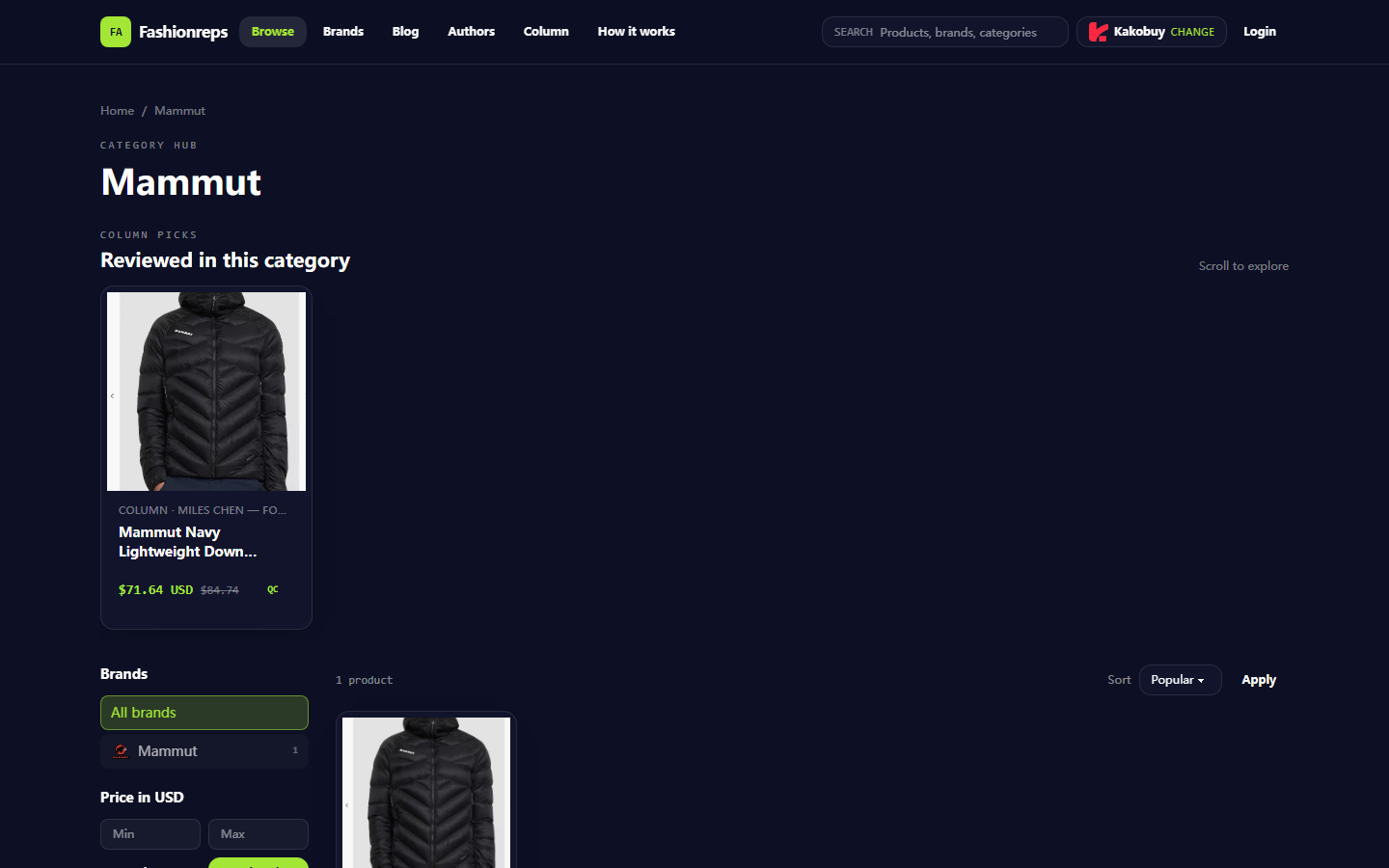
This article uses the Mammut category page on fashion-reps as a starting point to organize a pre-order verification process. The currently visible information on that category page shows that there is only one Mammut product, displayed as "Mammut Navy Lightweight Down Midlayer: Packable, Wind-Resistant, Built to Layer," with a reference price of $71.64 and a previous reference price of $84.74. Prices, stock, page status, and external purchase links may change, and readers should re-verify before actually ordering.

Reader Task and Verification Scope
This article is for people who have already seen a Mammut fall/winter jacket product page and are preparing to further confirm whether it's worth ordering. After reading, you should be able to do three things:
- Judge whether the product page provides enough fit, sizing, and construction evidence.
- Record page facts, image observations, and personal judgments separately.
- Pause the purchase when evidence is insufficient, and give the questions that need to be supplemented to the shopping agent or seller.
This article does not apply to scenarios that require confirming official authenticity, handling after-sales disputes, or replacing the destination country's import regulation judgment. The fashion-reps page mainly helps users discover products and compare shopping agents; orders, payment, warehousing, QC, shipping, and logistics are handled by the external shopping agent website chosen by the user. 🧭
What Information to Confirm First on the mammut Jacket Product Page
First confirm the basic facts of the product page, rather than judging "warmth" or "suitable for winter" based on images. At least record the following:
- Product name and specific style name.
- Product category: down midlayer, insulated jacket, softshell, hardshell, or other outerwear.
- Color shown on the page, such as Navy or other explicit color name.
- Current reference price, previous reference price, and price currency.
- Whether there is stock, size options, and available color options.
- Whether the main image, detail images, and size chart can be opened normally.
- Whether the Buy button currently points to the shopping agent you actively selected.
The "Lightweight Down Midlayer" label on the category page only indicates that the page positions it as a lightweight down midlayer; it cannot directly prove that it is suitable for severe cold, nor can it infer waterproof, stormproof, or complete outer layer functions from "Wind-Resistant." Page text is part of the product information, not a guarantee for all usage environments.
The page should also explain or at least allow further confirmation of insulation, fabric composition, length, cuffs, hem, pockets, collar type, and washing method. If this information is missing, do not fill it in yourself based on the brand name or product title.
How to Record Fit, Sizing, and Color Evidence Item by Item
First Distinguish Fit Description from Fit Conclusion
If the product page only says lightweight, packable, suitable for layering, it supports at most the limited judgment that it may be designed as a midlayer, worn between a base layer and an outer layer. Whether the body is loose or slim, whether the armholes allow enough movement, and whether the hem tends to roll up still require size data or clear images.
It is recommended to record in the following order:
- Check whether the size chart includes length, chest or half-chest, shoulder width, and sleeve length.
- Confirm whether the measurement unit is centimeters or inches, and keep the original values.
- Measure a well-fitting fall/winter jacket you own flat and compare key parts.
- Focus on shoulder width, chest, sleeve length, and length; don't just look at recommended height and weight.
- Record whether the size chart notes measurement tolerance and the incremental pattern between sizes.
If the page lacks a complete size chart, it is recommended to postpone the purchase and request flat measurements from the agent or seller. Model photos, brand impressions, or other buyers' height and weight alone cannot reliably replace your actual measurements.
Look for Physical Evidence for Color, Not Just the Color Name
When the page shows Navy, what can be confirmed is the page's color label, which does not mean the color is exactly the same on different screens. You should check:
- Whether the colors in the main image and detail images are consistent.
- Whether there is obvious color difference in the lining, zipper, cuffs, and quilting areas.
- Whether it can still be judged as the same color family under different lighting.
- Whether the images change synchronously when switching size or color variants.
If the image does not change after switching variants, or if the product name clearly conflicts with the image color, save a screenshot and confirm before ordering. Color issues are often difficult to explain through text after-sales, especially when the page does not clearly state return/exchange conditions. 🔎
How to Separate Page Facts and Editorial Judgments for Fabric, Construction, and Function Descriptions
Information can be divided into three layers:
| Information Level | What can be written in records | What should not be directly inferred |
|---|---|---|
| Page facts | Product name, color, reference price, functional terms marked on the page, visible construction | Real warmth level, actual windproof performance, durability |
| Image observation | Visible quilting, zippers, pockets, hood, cuffs, and hem construction | Internal fill amount, fabric feel, workmanship strength |
| Editorial judgment | May be suitable as a layering midlayer, risk points that need further confirmation | Personal wearing experience, measured performance, absolute recommendation |
For example, seeing quilting lines in the image does not mean the fill is even in every quilted compartment; seeing a zippered pocket does not mean the pocket is waterproof; seeing a lightweight appearance does not mean insufficient warmth in low temperatures. Editorial judgments should use expressions like "the page shows," "visible in the image," "the buyer should confirm," and avoid writing speculation as test results.
If the page does not clearly specify fill material, fill amount, fabric composition, or protection level, the article can at most remind the buyer to continue verifying and cannot supplement common brand parameters on its own. ✅
What to Do When Product Images and Page Text Are Inconsistent
When encountering inconsistency, pause the order first; do not submit the order immediately because of price or scarcity. Handle in the following order:
- Save the product name, color, size options, and current page screenshot.
- Mark the specific conflict, for example, the title says Navy but the main image looks more like black; the title says down midlayer but the page has no insulation description.
- Check whether it is a display error caused by images not updating for different variants.
- Ask the seller through the shopping agent about actual color, size measurements, and construction details.
- Request that the confirmation results be linked to the corresponding product link or order note.
- After arrival, use QC photos to check color, size, labels, zippers, stitching, and obvious stains.
QC photos can help detect appearance and size issues, but cannot prove fill composition, cold rating, or brand authenticity. If QC photos are insufficient to judge key risks, you can request additional photos; if the agent cannot provide necessary evidence, consider canceling or changing the product rather than treating uncertainty as default pass.
How to Judge Suitability for Fall/Winter Commute and Weekend Scenarios
For commuting, focus on length, collar, cuffs, pocket placement, and layering space. People who frequently move in and out of buildings may care more about lightweight, packability, and ease of putting on/taking off; but these features do not automatically equal suitability for prolonged outdoor stays.
For weekend outings, further confirm outer layer pairing, range of motion, and weather conditions. If the product is positioned as a midlayer on the page, it usually needs to be used with a shell or other protective layer. Rain, snow, strong wind, prolonged outdoor activity, and low temperatures should be judged based on clear fabric and construction information, not just the product title.
For buyers with large body proportion differences, chest and sleeve length are often more important than just the size letter. Those who like loose layering should not choose based only on their usual base layer size; those who prefer a close fit should not ignore the extra room needed for midlayer movement. 🧣
Pre-Order Product Page, QC, and Link Check List
Product Page Check
- Do the product name, color, and product images correspond to each other?
- Is the reference price marked with currency and re-verified for current status?
- Does the size chart include enough flat measurements?
- Is there a clear source for fabric, insulation, and construction information?
- Does the Buy button jump to the shopping agent you selected?
- Are there duplicate products, empty pages, or images that cannot be opened?
Ask the Agent or Seller
- Request measurements for the target size: length, chest, shoulder width, and sleeve length.
- Ask whether the actual color matches the main image on the page.
- Confirm whether clear photos of zippers, cuffs, hem, and inner labels can be provided.
- Ask about the return/exchange window and process if size or obvious defects are found.
- Do not send full order numbers, payment cards, passports, or unmasked personal address label photos.
QC Check Upon Arrival
- Check color, size labels, and quantity.
- Check for obvious asymmetry in left/right sleeves, shoulders, hem, and quilting areas.
- Check whether zippers are intact, pockets are sewn, and cuffs are damaged.
- Compare with confirmed measurements to judge significant deviations.
- For materials, fill amount, and performance that cannot be confirmed from photos, keep a record of "uncertain."
Stop Purchase Conditions When Evidence Is Insufficient
Stop the purchase first if any of the following occurs:
- Color, size, or product images cannot correspond to the same variant.
- The page lacks sufficient size data, and the agent cannot provide measurements.
- The product title claims a certain function, but the page has no construction or material evidence.
- Price, stock, or link status changes during confirmation, and there is no new verifiable information.
- QC images cannot cover the defect locations you care about most.
- Return/exchange conditions are unclear, and the product has obvious size or color risks.
- You need severe cold, waterproof, or high-intensity outdoor gear, but the page can only prove it may be a lightweight midlayer.
"Insufficient evidence" does not mean the product is definitely problematic, but that the current information is not enough to support bearing the purchase risk. Separating these two things is an important step to reduce impulse buying.
Next Steps After Completing Verification
If the product page, size data, images, and QC results correspond to each other, you can write the confirmed color, size, measurements, and risk points into the order note, and then order through the selected shopping agent. Afterwards, confirm separately warehousing, QC, return/exchange window, consolidation, and logistics information; do not equate product verification with shipping or customs guarantee.
If one key fact still cannot be confirmed, prioritize waiting for supplementary evidence or choose a product with more complete information. For this type of lightweight Mammut midlayer, clear verification can help reduce return/exchange costs due to misjudgment of size, color, or construction, but it cannot eliminate risks such as price fluctuations, stock changes, agent service fees, international shipping costs, destination country taxes, or shipping loss.
This method is more suitable for users who are willing to measure themselves, review QC, and bear the uncertainty of cross-border purchases; it is not suitable for those who need to wear it immediately upon arrival, require clear official after-sales, or must confirm extreme weather performance. If you cannot accept these risks, it is not recommended to buy based solely on the product title and a few images.